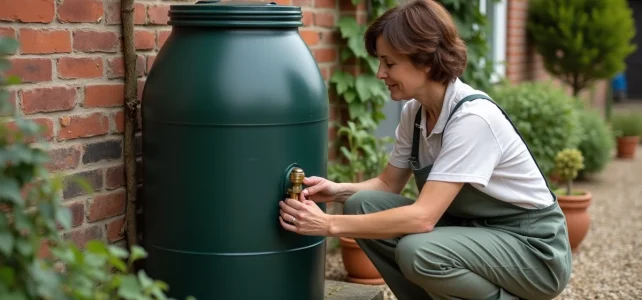
The quality of stored rainwater degrades well before the tank is empty. In the absence of renewal, a biofilm forms on the internal walls within a few days, especially above 20 °C. Knowing how to keep rainwater clean and store it relies less on the choice of container than on controlling flow, light, and temperature.
Overflow and Renewal: The First Lever for Stored Water Quality
A full rainwater collector that never overflows is a stagnant collector. We observe that the majority of odor and greening problems stem from an absent or poorly sized overflow, not from a filtration defect.
The overflow serves two functions. It evacuates the surplus to the stormwater network, and it causes mixing of the upper layer during each rain event. This mixing prevents thermal stratification that favors anaerobic bacteria at the bottom of the tank.
A properly sized overflow renews the surface layer with each rain. The connection should be made at the top, with a fine mesh mosquito screen. Without this screen, mosquito breeding in the overflow creates a health problem distinct from greening.
For large capacity tanks, we recommend positioning the pump suction at mid-height rather than at the bottom. Heavy sediments (pollen, mineral dust, roofing debris) concentrate in the last few centimeters. Drawing from the bottom accelerates clogging of downstream filters and degrades the quality of the distributed water. To delve into best practices, refer to this guide on how to keep rainwater clean and store it.
Upstream Filtration and Tank Materials: Decisive Technical Choices
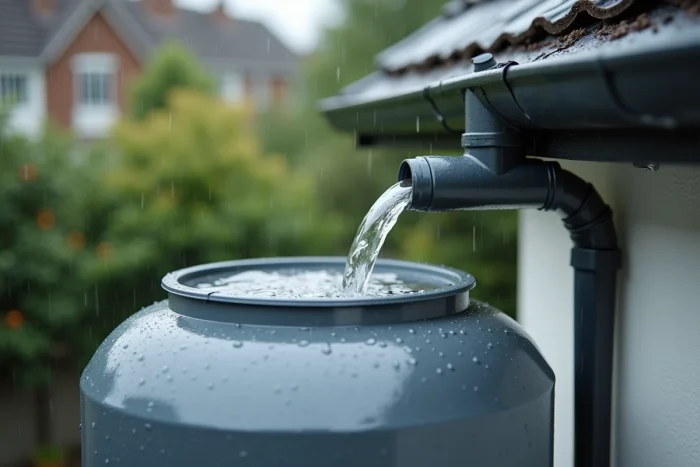
The most cost-effective filtration is placed before the tank, not after. A basket pre-filter at the downspout outlet captures leaves, moss, and shingle granules. This first stage reduces the organic load entering storage and slows down biofilm formation.
Upstream Filtration of the Tank
- A “dead leaves” type screen filter collects debris and can be cleaned in thirty seconds, stopping the majority of coarse debris before it ferments in the tank
- A fine mesh filter (around half a millimeter) installed between the gutter and the tank traps pollen and roofing particles, the main sources of turbidity and nutrients for algae
- A frog mouth at the downspout outlet prevents blockage of the downspout but does not replace a dedicated pre-filter for the collector
Tank Material and Opacity
The total opacity of the tank is the non-negotiable condition against algal proliferation. Dark-colored high-density polyethylene (HDPE) collectors block solar radiation. Translucent or semi-transparent tanks, even those advertised as “food grade,” allow enough light to trigger microalgae photosynthesis within a few days of sunlight.
Flexible tanks made of reinforced PVC offer a good compromise for spaces under terraces or crawl spaces. Their advantage: the absence of air above the water surface limits the oxygenation of the upper layer and reduces aerobic proliferation. However, they complicate annual inspection and cleaning.
Rainwater Storage Duration: The Variable Manufacturers Underestimate
Do not store rainwater for more than one to three weeks in a well-maintained, opaque tank protected from light. Beyond that, bacterial proliferation accelerates, odors appear, and the biofilm thickens to the point of contaminating each new filling.
This recommendation goes against the logic of “the bigger the tank, the better.” A one-thousand-liter tank used at a quarter capacity each week maintains a satisfactory renewal rate. The same tank filled once per season and drained drop by drop accumulates organic matter without evacuation.
In hot weather, the internal temperature of an above-ground tank exposed to the south can exceed levels favorable to bacteria. We recommend placing the tank on the north side of the building or under an awning. A simple facade shift divides direct solar exposure and stabilizes the temperature of the stored water.
French Regulations on Rainwater: Authorized Uses and Network Separation
The decree of August 21, 2008 sets the regulatory framework. Collected rainwater can supply toilets, floor washing, and, under certain conditions, washing machines. Drinking remains prohibited unless treated with approved methods and connected to a dedicated network compliant with the Public Health Code.
The main point of vigilance concerns the strict separation of drinking water and rainwater networks. Any connection between the two circuits requires a certified backflow prevention device. In the event of an inspection, the absence of disconnection exposes the owner to a formal notice.
Each withdrawal point supplied with rainwater must bear a “non-potable water” sign accompanied by a pictogram. This obligation also applies to garden taps connected to the tank, a detail often overlooked during self-construction installations.
Mandatory Annual Maintenance
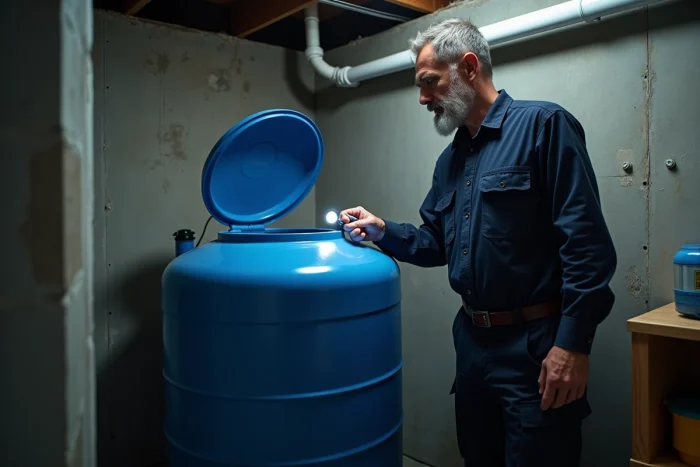
- Drain and clean the tank at least once a year, inspecting the walls for residual biofilm
- Check the proper functioning of filters, the overflow, and the backflow prevention device
- Record operations in a maintenance log, required in case of resale or health inspection
The sizing of the recovery system should be considered based on actual consumption rather than local rainfall. A tank that is too large relative to usage creates exactly the stagnation problem described above. Adapting the tank volume to the withdrawal rhythm remains the best guarantee of rainwater that remains usable between showers.