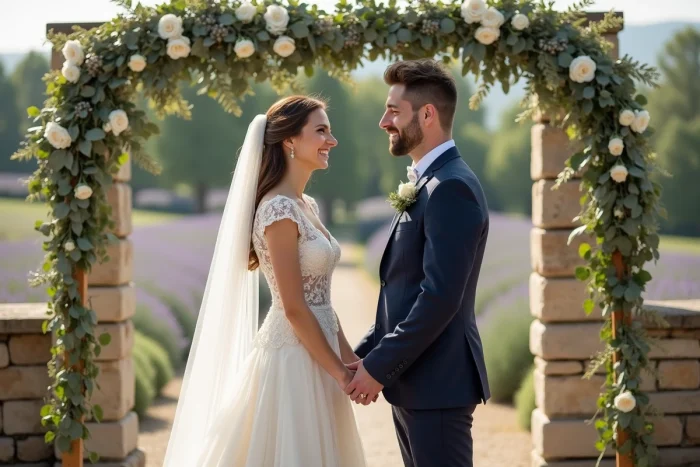
The wedding market in France is undergoing a period of restructuring. Since the post-Covid inflation surge, couples are adjusting their budgets, renegotiating signed quotes, and reducing the scope of certain services. At the same time, reception venues are imposing new environmental constraints that change the very way a wedding day is conceived. Organizing a wedding today means navigating between personal desires and a tightening framework.
Eco-responsible constraints of reception venues in France
Competitors extensively detail the choice of venue from an aesthetic or logistical perspective. They overlook a recent phenomenon: venues now impose an environmental specification on couples who book.
The Châteauform’ network indicates in its 2024 CSR report that nearly all of its event sites apply such constraints for weddings. Specifically, this translates into strict waste limitations, bans on certain plastics, reduced fireworks, and the requirement to work with a short list of local caterers.
For a couple, these rules change the game right from the scouting phase. Before falling in love with a castle or a vineyard, one must read the general rental conditions and check compatibility with the decoration project, choice of caterer, and planned entertainment. A beautiful venue whose specifications prohibit your favorite caterer or your flying lanterns becomes a problem, not a solution.
Some couples see this as an opportunity: these constraints simplify decisions by narrowing the field of possibilities. When the venue provides a list of three local caterers, the comparison is quickly made. Feedback on this point varies, as others perceive it as a loss of creative freedom.
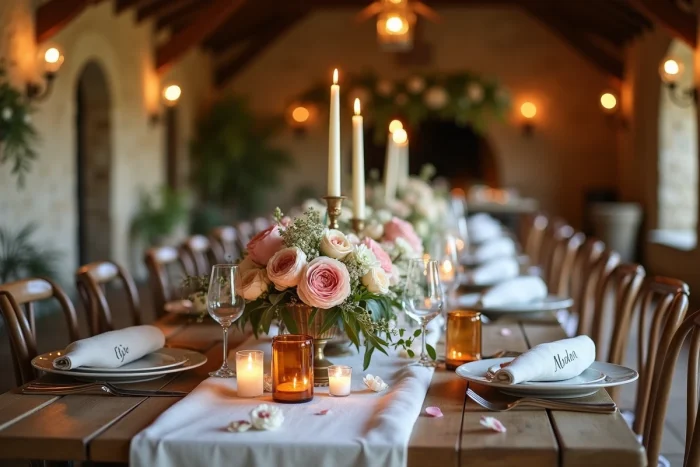
Wedding budget and renegotiation of quotes: what has changed since 2023
The FFM 2023-2024 Barometer from the French Wedding Federation confirms a clear trend: a growing share of couples are renegotiating already signed quotes with their service providers a few months before the big day. Before 2022, these renegotiations were marginal.
The most affected areas by these adjustments are menus (reducing the number of dishes, switching to a cocktail dinner), the duration of the evening, and decoration options. In other words, the overall budget is no longer set once and for all at the time of booking. It becomes a subject of ongoing discussion, even after signing.
Choosing service providers with whom communication remains fluid thus becomes a priority. A caterer or DJ who refuses any contractual modifications after signing can become a source of tension if the couple’s financial situation changes. Before signing a quote, it’s better to ask a simple question: what happens if we need to reduce a service in six months?
The ability to know everything about France Mariage also allows for comparing the contractual practices of different listed providers.
Wedding cancellation insurance: coverage to examine before booking
French insurers have developed since 2022-2023 dedicated offers covering cancellation or postponement for extensive reasons. These specific wedding cancellation insurance contracts constitute a safety net that the majority of couples only consider after incurring expenses.
Logically, subscription should occur as early as possible, ideally before paying the first deposit to the venue. Because this is when financial exposure begins. Available data does not allow for a conclusion on the actual subscription rate in France, but the increase in offers suggests a growing demand.
Some points to check in a wedding insurance contract:
- The scope of covered cancellation reasons (illness, accident, but also breakup, job loss depending on the contracts)
- The compensation ceiling relative to the total budget incurred, including deposits already paid to providers
- The reporting deadlines and exclusions (some contracts exclude cancellations decided less than 48 hours before the ceremony)
- The possibility of covering a postponement rather than a pure cancellation, which is often more relevant
Wedding planning: the trade-offs that no one makes at the right time
Most organization guides offer a linear checklist: date, budget, guest list, venue, providers. This approach overlooks the fact that wedding decisions are interdependent and not sequential.
The number of guests determines the venue. The venue conditions the caterer (especially with eco-responsible specifications). The caterer impacts the budget. The budget redefines the guest list. It’s a circular system, not a top-to-bottom checklist.
An early trade-off allows breaking out of this loop: set a maximum envelope per invited person and stick to it. This figure, even approximate, forces alignment of the number of guests with the desired level of service. A couple wanting a seated gourmet dinner for one hundred people will not have the same budget as a couple preferring a cocktail dinner for one hundred fifty close friends.

The secular ceremony also deserves an early trade-off. If the couple chooses a secular ceremony in addition to the civil ceremony, this adds an expense item (officiant, decoration, sound system) and a logistical constraint (compatible venue, timing of the day). It’s better to decide this point before booking the venue, not after.
Wedding service providers: when to book and in what order
The order of booking service providers is not trivial. The venue comes first because it conditions the date. The caterer comes second because most venues require this choice to be validated quickly. The photographer should be booked early as good professionals are often booked well in advance.
Items that can wait include stationery, floral decoration, and entertainment. Adjusting them at the end of the process offers budgetary flexibility if the couple needs to renegotiate other quotes along the way.
Hiring a wedding planner remains an option that each couple evaluates differently. A coordinator does not eliminate trade-offs; it structures them. For a medium-sized wedding, the question is not whether a planner is useful, but whether the couple has the time and energy to manage the coordination among a dozen providers over several months.
Weddings in France are now prepared within a more constrained framework than five years ago, amid inflation, environmental requirements from venues, and new insurance practices. Taking these parameters into account from the start, even before dreaming of the seating plan or choosing the DJ, remains the best way to avoid unpleasant surprises a few weeks before the ceremony.