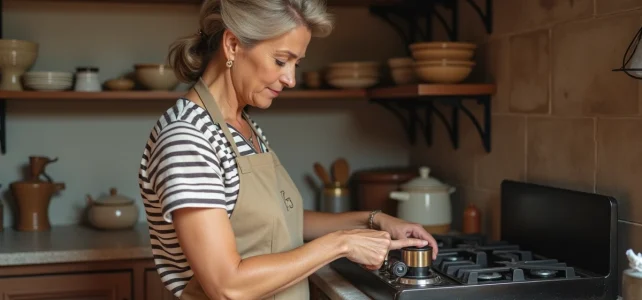
Converting 150 degrees in thermostat relies on a simple arithmetic formula, but applying it without considering the type of oven or cooking mode skews the result. The raw conversion gives thermostat 5, which is 150 divided by 30. However, this figure only tells part of the story: convection, traditional ovens, and gas ovens do not behave the same way at this temperature.
Thermostat and Celsius Conversion: Comparative Table by Oven Type
The basic rule is to divide the desired temperature by 30. For 150 °C, you get thermostat 5. The table below compares the most common thermostat positions with their equivalents in degrees, according to the type of oven.
| Thermostat | Traditional Oven (°C) | Convection Oven (°C) | Description |
|---|---|---|---|
| 3 | 90 | 70 | Gentle oven |
| 4 | 120 | 100 | Gentle oven |
| 5 | 150 | 130 | Medium oven |
| 6 | 180 | 160 | Medium oven |
| 7 | 210 | 190 | Hot oven |
| 8 | 240 | 220 | Very hot oven |
The difference between convection and static mode is around 20 °C less for convection. If your recipe indicates thermostat 5 without specifying the mode, set your oven to 130 °C in convection mode rather than 150 °C. Ignoring this distinction is the primary cause of overly dry desserts or burnt gratins on the surface.
To know precisely what thermostat corresponds to 150 degrees according to each level, the formula remains the same: temperature divided by 30.
Why 150 Degrees at Thermostat 5 Isn’t Always Enough
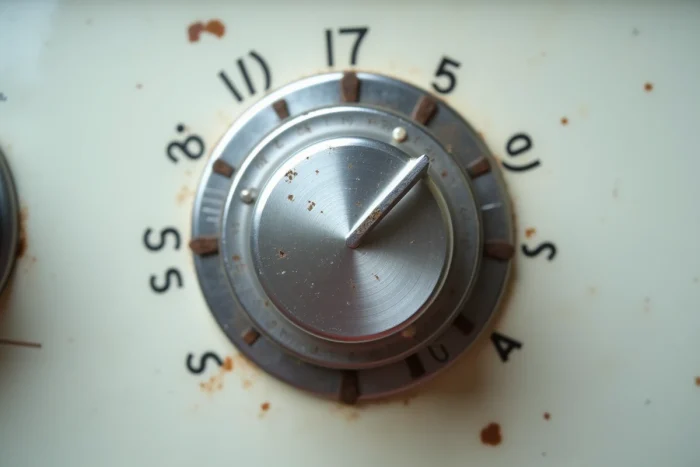
A mechanical thermostat indicates a position, not a reliable measurement. Manufacturers themselves recommend checking the actual temperature with an independent thermometer, as the knob’s graduation does not guarantee the exact temperature inside the chamber. An aging oven may display thermostat 5 while heating to 140 °C or even less.
Hot and cold spots further complicate matters. Most ovens have temperature variations between the top, center, and bottom of the cavity. For a sensitive recipe (meringues, sponge cake, flan), these few degrees of difference can change the final result.
Checking the Actual Temperature of Your Oven
A dial or probe oven thermometer is inexpensive and can be placed directly on the rack. After complete preheating, compare the displayed value with the selected thermostat. If the difference exceeds ten degrees, adjust your thermostat position accordingly.
This check is especially important for older gas ovens, whose mechanical thermostats can become miscalibrated over time. A regularly recalibrated oven provides more consistent cooking than a new oven that has never been checked.
Typical Cooking at 150 °C: Adjusting the Thermostat for Each Recipe
Thermostat 5 (150 °C in static mode) corresponds to a medium oven. This level is suitable for long, gentle cooking, where heat must penetrate gradually without coloring the surface too quickly.
- Soft cakes and loaves: the moderate temperature allows for even rising without a thick crust. Allow for a longer cooking time than at thermostat 6.
- Vegetable gratins: cheese melts and browns slowly, vegetables cook through without drying out.
- Braised meats and oven stews: thermostat 5 maintains a constant simmer, close to cooking in a pot over low heat.
- Meringues and drying: some recipes even go below 150 °C for slow drying. In convection mode, lowering to 120 – 130 °C reproduces this effect.
In convection mode, always reduce by about 20 °C compared to the temperature indicated for a static oven. If the recipe mentions “thermostat 5” and your oven is convection, set it to 130 °C instead of 150 °C.
The Influence of the Pan on Cooking at Thermostat 5
The material of the dish alters how heat reaches the food. A clay dish absorbs heat gradually and returns it evenly, which is well-suited for slow cooking at 150 °C. In contrast, a thin metal pan conducts heat faster: the base of the cake may cook more quickly than the center.
A clay dish at thermostat 5 extends the cooking time by a few minutes compared to the same dish in metal. Adjust the time, not the temperature.
Fahrenheit and Thermostat: Converting an Anglo-Saxon Recipe at 300 °F
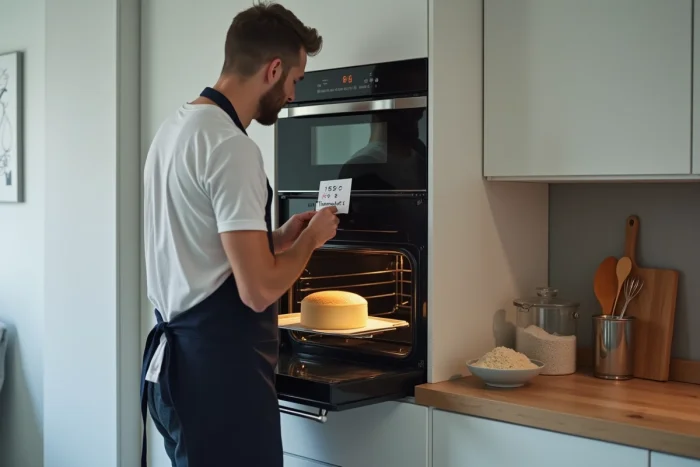
American or British recipes express temperature in degrees Fahrenheit. The value 300 °F corresponds to about 150 °C, or thermostat 5. To convert Fahrenheit to Celsius, subtract 32 and then multiply by 5/9.
This additional conversion often trips up cooks following online recipes without checking the unit. Setting to 300 °C instead of 300 °F can char the dish in minutes. Always check the temperature unit before turning the knob.
The formula thermostat = temperature (°C) / 30 remains the quickest way to navigate between systems. For 150 °C (or 300 °F), the result is always thermostat 5, to be adjusted later according to the cooking mode and the actual state of your oven. A simple control thermometer turns an estimate into a reliable measurement, and it is often this small tool that makes the difference between a successful cook and a failed dish.