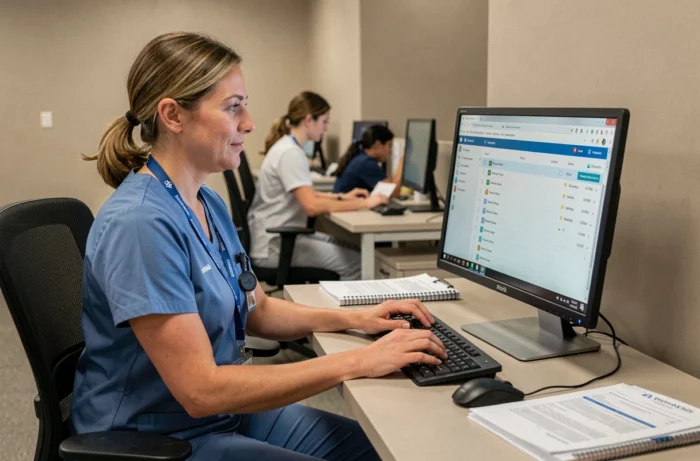
The professional messaging system of the CHU of Montpellier relies on multi-factor authentication combined with a site-segmented network. For an agent attempting to connect, the combination of these two technical constraints transforms a mundane action (checking emails) into a process where the order of operations is as important as the credentials themselves.
Browser or mobile application: impact on hospital data security
Before discussing the connection procedure, an upstream choice determines the level of data exposure. The browser opens a temporary session, which closes upon logout or after a period of inactivity. No messages or attachments are stored locally on the device.
The mobile application, on the other hand, can locally synchronize messages and their attachments on the agent’s phone. In a hospital context, where exchanges regularly contain health information, this difference is significant.
| Criterion | Browser (web session) | Mobile application |
|---|---|---|
| Local storage of messages | None | Possible synchronization on the device |
| Session persistence | Automatically closes after inactivity | Session maintained in the background |
| Risk in case of device loss | Low (nothing stored) | High (messages and attachments accessible) |
| Compatibility with shared devices | Suitable (simple logout) | Unsuitable (account tied to the device) |
For agents working on shared devices in care rooms or on-call offices, the browser remains the safest access mode. The mobile application is more justified for managers or practitioners who have a dedicated professional device.
A detailed guide on the messaging for agents of CHU Montpellier describes the functional differences between these two access modes.

MFA Enrollment at CHU Montpellier: the network constraint that no one clearly displays
MFA enrollment must be done from the internal network of the CHU. This requirement is the main blockage point during the first connection. Attempting to activate the one-time code from a guest Wi-Fi, from home, or via a mobile hotspot does not trigger any explicit error message: the procedure fails silently.
The agent must be physically present in a department of the CHU, connected to the wired network or professional Wi-Fi, to initiate the association between their account and the authentication application (such as Microsoft Authenticator). Once this enrollment is validated on the internal network, connections from outside become possible.
Concrete steps for initial enrollment
- Go to a department of the CHU and connect to the professional network (wired or internal Wi-Fi, not the guest network)
- Open the CHU authentication portal from a browser and enter the credentials provided by the IT department
- Follow the procedure to associate with the authentication application on their personal or professional phone
- Validate the one-time code generated by the application to confirm the enrollment
After this step, remote access works normally. Any attempt to enroll outside the internal network will fail without alert, which explains the majority of support tickets related to the first connection.
Lost phone and desynchronized MFA: two distinct blockages
A forgotten password can be reset in a few minutes via the standard procedure. The loss or replacement of the phone associated with the MFA involves a completely different process.
Resetting the second factor requires intervention from IT support. The agent cannot re-associate a new device with their account on their own. This dependency creates a variable downtime depending on the workload of the support service.
Expired password versus lost phone
An expired password can be handled in self-service from the authentication portal. The process remains accessible even from outside the network, provided that the MFA enrollment has already been completed.
The loss of the phone, on the other hand, cuts access to the second factor. The agent must contact support, prove their identity, and then redo the enrollment procedure from the internal network. This mandatory double step (support then internal network) extends the recovery time.

Access lifecycle management: arrival, transfer, departure
Access to the CHU messaging system is not limited to a username and password. Rights are linked to the position held. During an internal transfer, a change of department, or departure, access must be deactivated and then reallocated according to the new scope.
This identity lifecycle management implies that an agent changing departments may temporarily lose access to their messaging while rights are being reconfigured. The intranet portal and business applications follow the same reallocation logic.
- Arrival: account creation, rights allocation according to the department, mandatory on-site MFA enrollment
- Transfer: deactivation of old rights, reallocation to the new scope, sometimes requiring re-enrollment
- Departure: complete deactivation of the account and removal of remote access
Each change of position may involve a new MFA enrollment. Agents frequently transferred between departments should anticipate this step with IT support before their effective start date.
Access to the messaging system of CHU Montpellier depends less on knowing a URL than on mastering the technical sequencing: enrollment on the internal network first, choosing the access mode suitable for their position next, and anticipating blocking cases related to the phone or changes in service.