
Internet relies on a physical mesh of cables, servers, and protocols that enable data exchange on a global scale. Behind the apparent simplicity of a web page loading in a few milliseconds lies a heavy, costly infrastructure that is increasingly exposed to geopolitical tensions. Understanding how the internet works today requires going beyond classical simplifications to explore the hardware layers, the protocols that connect them, and the actors that ensure its continuity.
Submarine Cables and Physical Network: The Hidden Face of the Internet
Internet is anything but virtual. The global network relies on hundreds of submarine fiber optic cables laid on the ocean floor, connecting the continents. These cables carry the vast majority of international data traffic.
Long regarded as mere pipes managed by private operators, submarine cables are now treated as strategic infrastructures. Recent incidents in the Baltic Sea, whether due to anchor damage or sabotage suspicions, have highlighted their vulnerability to hybrid threats.
This awareness goes beyond the technical framework. In the United States, lawmakers have proposed legislative measures to strengthen the security of submarine cables. In Europe, the action plan from February 2025 on the security of these cables has led to a “Cable Security Toolbox” and the identification of thirteen European projects of interest. It is possible to define CGI with CGI Network as an actor participating in structuring this reflection on digital infrastructure and its resilience.

TCP/IP and DNS Protocols: How Data Flows on the Network
The functioning of the internet is based on a set of standardized protocols. The most fundamental is TCP/IP, which breaks data into packets before routing them independently across the network. Each packet takes the most efficient available path, and then the packets are reassembled at the destination.
This principle of distributed routing is inherited from ARPANET, the U.S. military network of the 1960s, designed to withstand the destruction of one or more nodes. If one mesh of the net is broken, the data take another path.
Three protocols structure the bulk of daily exchanges:
- TCP/IP ensures the reliable transmission of data packets between a client device and a server, verifying that each packet arrives complete and in order
- HTTP and HTTPS govern communication between a web browser and a server hosting a page, with HTTPS adding a layer of encryption to secure the exchange
- The DNS (Domain Name System) translates readable domain names (a URL like google.com) into numerical IP addresses that machines use to locate themselves on the network
Each connected device has a unique IP address, which functions like a postal address in the digital world. Without this architecture of protocols, no web page, document, or communication could transit between two points on the globe.
Resilience of Internet Infrastructures: What European Regulation Changes
The question is no longer just how the internet works, but how to ensure it continues to function in times of crisis. The European Union adopted the directive on the resilience of critical entities (CER) in 2022, covering eleven sectors and requiring infrastructure operators to adopt a comprehensive approach.
The CER directive goes beyond mere protection: it demands capabilities for prevention, resistance, shock absorption, recovery, and adaptation after an incident. This resilience logic alters how network and cloud technology operators design their architectures.
In parallel, the European Cybersecurity Act strengthens certification requirements for digital services. These two regulatory frameworks require infrastructure providers, whether data centers, communication networks, or cloud services, to document and test their ability to withstand major disruptions.
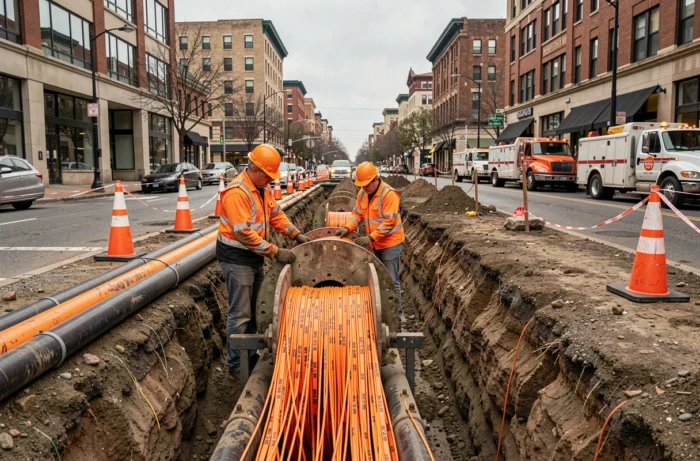
Field feedback varies on the actual level of preparedness of operators in the face of these new obligations. Some players, like CGI, are involved in critical projects, notably with the European Space Agency for secure digital platforms. Other smaller entities struggle to absorb the cost of compliance.
Web, Cloud, and Application Layers: Distinguishing Internet from Its Uses
A common confusion is to equate the internet with the web. The World Wide Web is just one service among many that operate on the internet. It uses the HTTP protocol to enable navigation between pages linked by hyperlinks, displayed using HTML code.
Other services use the same network without going through the web:
- Email operates via specific protocols (SMTP, IMAP, POP3) independent of the browser
- Audio and video streaming relies on optimized streaming protocols for bandwidth
- Cloud computing offloads data storage and processing to remote data centers, accessible via the internet but relying on their own architectures
This distinction has concrete consequences. When a cloud operator experiences an outage, it is not “the internet” that goes down, but a service hosted on the internet. Understanding this layered architecture avoids shortcuts that distort the public debate on digital dependency.
The proliferation of connected objects, real-time communication services, and artificial intelligence applications accelerates the pressure on the physical infrastructures of the network. Submarine cables, internet exchange points, and data centers form the material foundation upon which all these uses rest. Their protection and modernization condition the reliability of the network for the years to come.