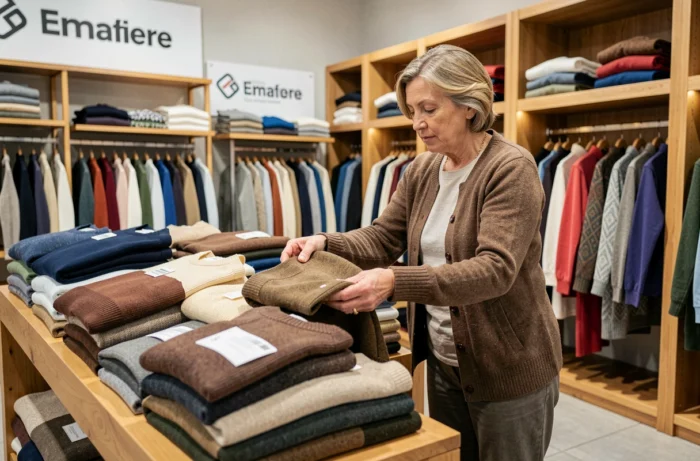
When thinking of warm and comfortable clothing, Damart often comes to mind. However, the French textile market is not limited to a single brand. Several brands occupy similar segments, sometimes with comparable technologies, sometimes with very different pricing or distribution strategies. Understanding who truly competes with Damart requires looking beyond the simple product catalog.
Distribution Channels: The Real Arena of Textile Competition
Have you noticed that some brands once limited to mail order are now found in supermarkets? This is exactly the shift taken by Damart, whose arrival is announced in over 1,100 large retail stores (Carrefour, E.Leclerc, La Halle), with products priced below 20 euros.
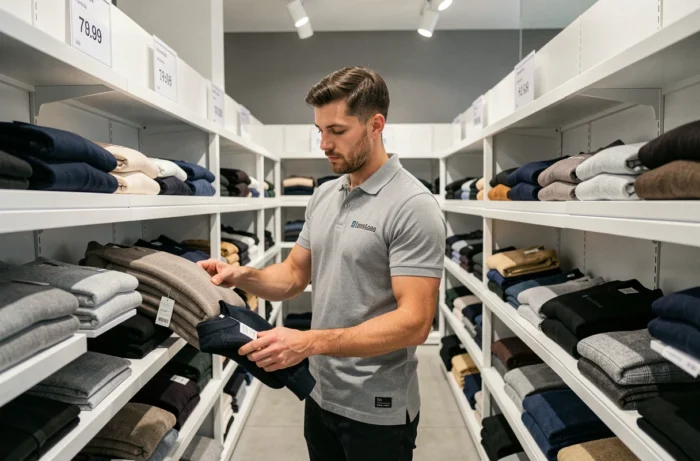
This change in distribution channels reshuffles the deck. Damart is no longer only competing against thermal clothing specialists. The brand now faces the private label brands of large retailers, the technical ranges of Decathlon, and the accessible collections of Uniqlo, all present in the same aisles.
To identify Damart’s competing brands, one must compare both the points of sale and the products. A brand absent from large retail does not play in the same arena as a brand accessible throughout France.
Presence on marketplaces is as important as physical networks. Damart is now listed on about thirty marketplaces across nine European countries. Competitors lacking this digital reach are consequently less visible to customers accustomed to comparing online before purchasing.
Thermal Technologies: Thermolactyl vs. Alternatives
Thermolactyl remains Damart’s signature. This thermoregulating fiber has built the brand’s reputation for decades. However, other technologies occupy the same niche.
Uniqlo and the HeatTech Range
Uniqlo offers its HeatTech technology, designed to retain body heat while remaining lightweight. The pricing position is comparable to that of Damart in large retail. The difference lies in style: Uniqlo targets a younger clientele, with fitted cuts and urban colors.
Decathlon and the Wedze Range
Decathlon approaches thermal clothing from a sports angle. Its Wedze range (now an integral part of the mountain offering) offers technical underwear at low prices. Decathlon competes with Damart on functionality, not on everyday style. A consumer looking for a warm under-sweater for winter may legitimately hesitate between the two.
Patagonia and The North Face
These two brands position themselves in a more upscale segment. Their argument is based on the durability of materials and a stated commitment to eco-responsibility. They do not directly target the same clientele as Damart but capture part of the buyers sensitive to quality craftsmanship and willing to invest more.
Profitability vs. Sales Volume: Two Ways to Measure Competition
Damart’s revenue has declined in the recent fiscal year, while the profitability of its parent company’s fashion division has improved. This gap between volume and margin illustrates a reality often overlooked when comparing textile brands.
A competitor can sell less and earn more. Ranking Damart’s rivals solely by notoriety or number of stores gives an incomplete picture. A brand like Petit Bateau, for example, generates more modest revenue in the thermal segment, but its margins on basic cotton items are solid.
To assess the real competitive pressure, three criteria deserve to be crossed:
- The sales volume in the warm and technical clothing segment, which indicates the direct market share
- The operating margin, which reveals a brand’s ability to invest in innovation or distribution
- The customer loyalty rate, difficult to measure from the outside but visible through loyalty programs and purchase recurrence

Regulation and Manufacturing Origin: The New Differentiation Criteria
France has initiated stricter regulations on ultra-fast fashion. This regulatory evolution changes the competitive conditions for all textile brands, including those competing with Damart.
Brands with a moderate renewal rate benefit from this regulation. Damart, which renews its collections in a classic seasonal manner, is mechanically better positioned than brands whose model relies on weekly micro-collections.
Displaying the origin of manufacturing is also becoming a commercial argument. Consumers are increasingly looking at labels. A brand that manufactures in France or nearby Europe can turn this transparency into an advantage over competitors whose production is relocated further away.
Why does this criterion matter for identifying Damart’s true competitors? Because a brand subject to different regulatory constraints (production outside the EU, ultra-rapid renewal) does not play by the same rules. The comparison must integrate this dimension to be relevant.
Practical Framework for Comparing Damart’s Competitors
Rather than creating an alphabetical list, here are the concrete axes to examine to position each brand relative to Damart:
- Textile technology: does the brand offer a proprietary thermoregulating fiber comparable to Thermolactyl, or does it rely on standard materials?
- Distribution circuit: online sales only, network of boutiques, presence in large retail, or a combination of the three?
- Generational target: does the brand target Damart’s loyal seniors, a younger clientele, or a sports audience?
- Commitment to origin: French, European, or relocated manufacturing, and level of transparency in the production chain?
Comparing Damart’s competitors without crossing these four axes is like comparing apples and oranges. Uniqlo and Patagonia are both among the cited alternatives, but their business models have almost nothing in common.
The French textile market is restructuring around expanded physical distribution, anti-fast fashion regulations, and transparency regarding product origins. The brands competing with Damart in 2025 may not necessarily be those one would have mentioned ten years ago. Monitoring the aisles of your supermarket sometimes provides a better understanding of the competitive landscape than any theoretical ranking.