The DIY, decor, and garden market no longer revolves solely around visual appeal. The demand is for outdoor spaces that remain usable above 35 °C, that require neither annual sanding nor daily watering, and that fit on a balcony of a few square meters. This refocusing on usability changes material choices, furniture formats, and even the design of shaded areas.
Outdoor thermal comfort: shading solutions that truly change the perceived temperature
A cantilever umbrella or a textile shade sail is no longer sufficient to meet the thermal constraints of recent summers. We are observing a shift towards structures that combine solar filtration and passive ventilation, where the choice of fabric is as important as the covered area.
Micro-perforated HDPE (high-density polyethylene) fabrics filter a significant portion of UV rays while allowing air to circulate through convection. The result: the temperature under HDPE fabric remains significantly lower than that under a solid awning. This type of product, long reserved for landscaping professionals, is becoming mainstream in DIY retail chains.
Bioclimatic pergolas with adjustable slats represent another technical avenue. The interest lies in adjusting the angle of the slats according to the sun’s path, allowing for shade modulation without moving the structure. When closed, they protect from rain. When open, they create vertical air circulation. The cost remains high, but self-supporting kit models are emerging, accessible without masonry intervention.
- HDPE shade sail: lightweight, easy to tension between two anchor points, suitable for balconies and small terraces. Limited wind resistance.
- Bioclimatic pergola with slats: adjustable, durable, but requires a stable ground and a larger budget.
- Willow or bamboo screening on a metal frame: intermediate solution, natural aesthetic, lifespan of a few seasons without treatment.
- Climbing plants on steel trellis: gradual shading, cooling through evapotranspiration, but installation takes several months.
The selection criterion is no longer style, but the actual capacity of the structure to lower the perceived temperature in the outdoor living area. Product sheets are starting to display a solar protection index, a sign that the market is integrating this requirement.
Natural furniture and minimal maintenance: teak, woven fibers, and mineral resins
Outdoor furniture made from natural materials dominates the spring-summer catalogs, but the approach has changed. It’s no longer about placing a rattan lounge for the image: we recommend selecting materials that age without intervention. Teak, for example, naturally grays without losing its mechanical strength. A simple rinse with a hose is sufficient each season, making it relevant in urban contexts where winter storage is impossible.
Synthetic woven fibers (woven polyethylene resin on an aluminum frame) mimic rattan or wicker while resisting UV rays and moisture. They do not mold, do not deform, and their reduced weight makes them easy to move on a balcony. The news on Brico Déco Jardin confirms this upgrade in woven fibers, which are no longer limited to chairs but now cover coffee tables, modular benches, and integrated planters.
Natural furniture visually extends the home outdoors, through mineral shades (stoneware, terracotta, beige stone) that match interior finishes. This continuity is a strong marker of current outdoor decoration: the idea of an “outdoor room” replaces that of a separate garden space.
Mineral materials: fiber-reinforced concrete and outdoor terrazzo
Tabletops made of lightweight fiber-reinforced concrete or terrazzo resist frost, stains, and thermal shocks. Their weight is reduced compared to traditional concrete thanks to the incorporation of glass fibers. A fiber-reinforced concrete tabletop requires no surface treatment and retains its raw appearance for several years.
This type of furniture meets a dual need: durability without maintenance and a sober aesthetic compatible with small spaces. A round terrazzo tabletop on a metal base takes up less space than a solid wood table, while offering superior weather resistance.
Small urban spaces: balcony and micro-terrace transformed into living areas
The clearest trend on balconies concerns solar garlands as a true scenographic tool, no longer just as simple supplementary lighting. Recent models offer varied shapes (globes, lanterns, exposed filaments) and sufficient autonomy to function for several hours after sunset. Fixed high on a taut cable, they create a luminous ceiling that gives the impression of volume to a small space.
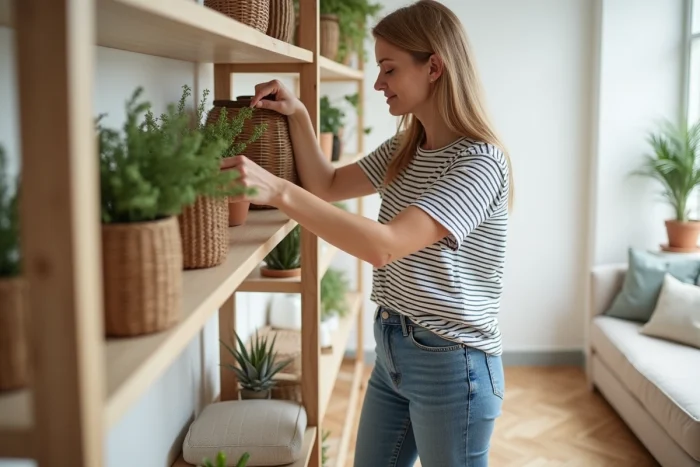
On micro-terraces, vertical gardening replaces pots lined up on the ground. Wall-mounted textile pocket systems or tiered planters allow for growing herbs and small plants without encroaching on usable space. This simple DIY (a few fixings, a geotextile felt, a frame made of battens) costs very little and transforms a blind wall into a green surface.
- Vertical planter in felt: lightweight, minimal wall drilling, suitable for rental walls.
- Treated wood tiered shelf: self-supporting, movable, accommodates multiple levels of pots.
- Metal trellis with S-hooks: modular solution for suspending various pots without drilling.
The goal is no longer to decorate a balcony, but to make it a functional space where one can eat, work, or relax. The choice of folding furniture with comfortable seating (rather than low-quality folding chairs) and water-repellent outdoor textiles contributes to this transformation.
Budget-friendly garden DIY: repurpose rather than buy
Low-cost outdoor DIY is becoming more sophisticated. Transforming an old sheet into a hammock suspended between two anchor points, customizing a garden seat with scraps of outdoor fabric, or making a concrete planter molded in a bucket: these projects frequently appear in searches for home crafts.
The technical interest lies in the choice of reclaimed materials. A thick cotton sheet can support a sufficient load if doubled and sewn with reinforcements at the suspension points. A homemade molded concrete planter costs a fraction of the price of a decorative pot from a garden center, for a highly sought-after raw finish.
These projects meet a specific need: to obtain a personalized outdoor space without investing in new furniture or accessories. DIY is becoming a full-fledged decoration lever again, not just a repair activity.
The DIY-decor-garden market is shifting towards products that solve concrete problems: heat, lack of space, tight budgets. The upcoming seasons will confirm whether retailers sustainably adapt their ranges to these constraints or if the offering remains driven solely by aesthetics.