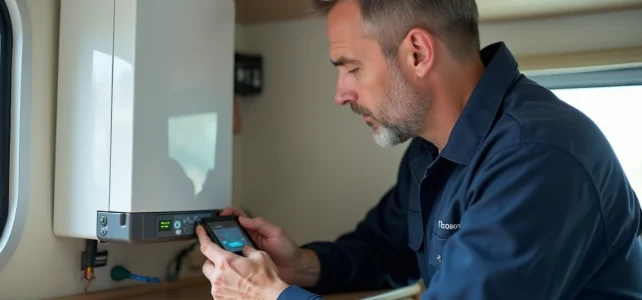
When an error code appears on the Truma control panel, the first question is not what it means, but what it requires: a simple restart, a check of the power supply, or the intervention of a certified technician. Truma error codes cover very different situations, from temporary locking after a gas cut-off to an internal burner fault. Knowing how to sort these alerts avoids unnecessary actions and cold nights without heating.
Temporary locking, power supply fault, or service failure: sorting before any action
Not all Truma error codes are equal. Some disappear after a cycle of shutdown and restart. Others persist as long as the physical cause is not corrected. A third group indicates an internal malfunction that requires specific tools and skills.
The first reflex when faced with a code displayed on the CP plus panel is to turn off the device, wait a few seconds, and then restart a cycle. If the code reappears immediately, it is not a temporary lock.
- Temporary locking: the system has detected a one-time anomaly (unstable flame, micro power cut). A restart is sufficient in most cases.
- Power supply fault: the battery voltage is too low or the gas circuit is interrupted. The code persists as long as the power supply is not restored. Checking the voltage at the terminals and ensuring the gas valve is open often resolves the issue.
- Internal failure requiring service: the code points to a component (sensor, electronic board, burner). The Truma CP plus documentation specifies that installation and repair must be carried out only by a specialist. Attempting disassembly without authorization voids the warranty and poses a real risk on a gas circuit.
Before trying to interpret each code individually, this sorting into three categories helps guide the next steps. To find the complete list of Truma error codes, each code is associated with its meaning and the corresponding level of intervention.
Truma Combi error codes: quick reference table by category
The CP plus panel displays codes in the form of letters and numbers, sometimes accompanied by a flashing red light. The table below groups the most common codes according to their origin, allowing you to know immediately if you can act yourself or not.
| Code Type | Probable Origin | Possible User Action | Service Required |
|---|---|---|---|
| Ignition-related codes (flame error) | Empty bottle, closed valve, air in the gas circuit | Check valve, bleed the circuit, restart | No (unless recurring) |
| Electrical voltage-related codes | Low battery, poor contact on the wiring harness | Measure voltage, recharge or tighten terminals | No |
| Overheating-related codes | Blocked air ducts, stuck fan | Clear air outlets, check for obstructions | Yes if the fan is involved |
| Sensor or board-related codes | Faulty temperature sensor, electronic board | No manipulation recommended | Yes |
| Hot water circuit-related codes | Improperly positioned drain valve, unbled circuit | Close the valve, bleed the circuit | No (unless persistent leak) |
This breakdown shows that the majority of common codes relate to gas or electrical supply. Internal component failures are rarer but always require a workshop visit.
Gas and battery supply errors: the two causes that users underestimate
On camper forums, ignition-related error codes generate the most discussions. The reason is simple: a bottle that gradually empties or a low charge battery produces symptoms similar to a hardware failure.
Gas circuit: purge and pressure
After changing the bottle, air remains trapped in the line. The Truma Combi attempts several ignitions, fails, and then displays a flame error code. Two to three restart attempts are usually sufficient to purge the residual air. If the code persists beyond that, the regulator or hose deserves inspection.
The quality of the gas also plays a role. In winter, propane remains usable at low temperatures, while butane does not liquefy well below zero. An unsuitable mixture for the season can cause recurring error codes without any component being faulty.
Battery voltage: the critical threshold
The CP plus panel and the Combi system operate at low voltage. When the battery drops below a certain threshold, the control electronics no longer receive enough current to operate the ignition or the fan. The error code that appears may seem to indicate a component failure, while the problem is purely electrical.
However, if the voltage measured at the battery terminals is correct and the code persists, the wiring harness between the battery and the device should be checked. A poor contact on an oxidized terminal is enough to cause a localized voltage drop.
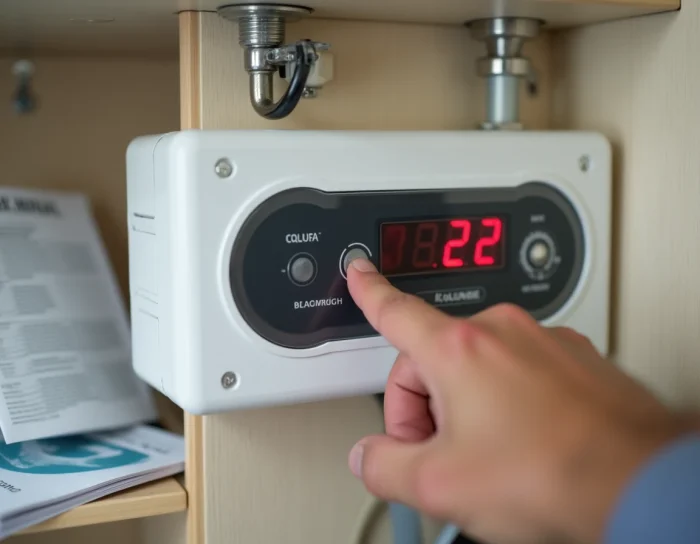
Flashing red light on the CP plus panel: what the rhythm indicates
The red light on the CP plus control panel does not function like a simple on/off indicator. The number of flashes and their rhythm correspond to different families of codes. A slow and steady flash does not convey the same message as a rapid series followed by a pause.
The Truma manual associates each sequence with a numerical code. Note the exact number of flashes before the pause is the most useful information to convey to a technician, much more than a verbal description of the symptom. A certified Truma workshop can identify the fault within minutes based on this information.
If the light remains steady (continuously lit without flashing), the situation is different: the system is generally in complete lock mode. A prolonged shutdown, followed by a power-up after checking the gas and battery, is the standard procedure. A steady light that does not turn off after this action indicates a mandatory visit to service.
The distinction between temporary locking and actual failure relies on three concrete data points: the behavior of the light, the state of the gas supply, and the measured battery voltage. With these three elements, most Truma error codes can be explained without disassembly, and cases requiring a specialist stand out on their own.