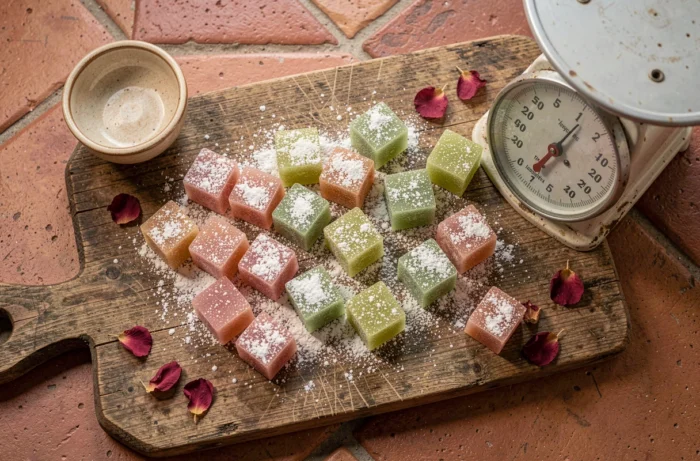
Turkish delight remains a confectionery whose basic composition (sugar, starch, water) seems simple, but whose caloric profile and actual shelf life vary much more than is usually stated. Here we detail the technical parameters that directly influence the preservation and calories of Turkish delight, and the concrete trade-offs to enjoy it without disrupting a dietary plan.
Water activity and actual shelf life of homemade Turkish delight
The longevity of Turkish delight primarily depends on its residual water activity after cooking. Poorly dehydrated artisanal Turkish delight develops surface mold within a few days, whereas a properly cooked and dried batch can last several weeks at room temperature.
The degree of cooking of the syrup is the first lever. The higher the final temperature of the sugar-starch mixture, the lower the residual moisture and the more stable the confectionery becomes. A difference of a few degrees radically changes the texture and shelf life.
Post-cutting drying plays an equally crucial role. Allowing the pieces to rest in the open air for several hours before coating helps evaporate the excess surface water. We recommend separating each piece with parchment paper to prevent sticking and limit moisture migration between pieces.
To delve deeper into the aspects related to the preservation and calories of Turkish delight, several technical parameters deserve particular attention during homemade production.

Refrigerator or cupboard: the right storage choice
Contrary to a common reflex, the refrigerator is not the best option for homemade Turkish delights. The cold promotes condensation upon returning to room temperature, which softens the sugar-starch coating and accelerates degradation.
A dry cupboard, away from light, in an airtight box lined with cornstarch, offers a much more stable environment. The ideal temperature is between 15 and 20 °C. In summer, if the room regularly exceeds these values, a brief stint in the refrigerator remains acceptable, provided it is consumed quickly after removal.
Caloric variability depending on fillings and coatings
Announcing a single caloric value for “Turkish delight” makes no technical sense. The energy density fluctuates significantly from one variant to another, and this is precisely the point that most nutritional labels oversimplify.
Plain, pistachio, or chocolate Turkish delight: three distinct profiles
A plain Turkish delight (sugar, starch, rose water) has the lightest profile in the range. As soon as nuts (pistachio, hazelnut, almond) are added, the lipid content increases significantly, raising the total calories per piece. A Turkish delight coated in chocolate or shredded coconut takes it a step further.
The table below illustrates these differences on an indicative basis:
| Type of Turkish delight | Relative energy profile | Dominant component |
|---|---|---|
| Plain (rose, lemon) | The lowest in the range | Sugar + starch |
| Pistachio or hazelnut | Moderately higher | Sugar + lipids from nuts |
| Chocolate or coconut coated | The highest | Sugar + added fats |
The trap of counting pieces
Counting “two Turkish delights” or “three Turkish delights” provides no reliable information. The unit weight varies from simple to double depending on the manufacturer and filling. We observe that weighing the portion in grams remains the only reliable control method. A reasonable portion is around 30 to 40 g, which corresponds to an energy intake comparable to that of a standard cereal bar.
Commercial Turkish delights: allergens and cross-contamination to check
Industrial or semi-artisanal Turkish delights frequently contain nuts, sometimes not clearly mentioned on the packaging when it comes to cross-contamination in the workshop. For allergic individuals, vigilance goes beyond simply reading the ingredient list.
- Check for the mention “may contain traces of”: pistachio, almond, and hazelnut are the most common allergens in Eastern confectionery workshops.
- Prefer brands that display a traceable batch number and a list of allergens compliant with European consumer information regulations.
- Turkish delights sold in bulk at markets or fine grocery stores rarely provide a complete allergen sheet: asking the seller directly remains the only option.
This point is even more relevant as product recalls concerning Eastern confectioneries regularly appear in official food safety databases.
Concrete strategies to integrate Turkish delight into a balanced diet
The key is not to eliminate Turkish delight but to control the context of consumption. A few simple trade-offs change the actual impact on daily energy balance.
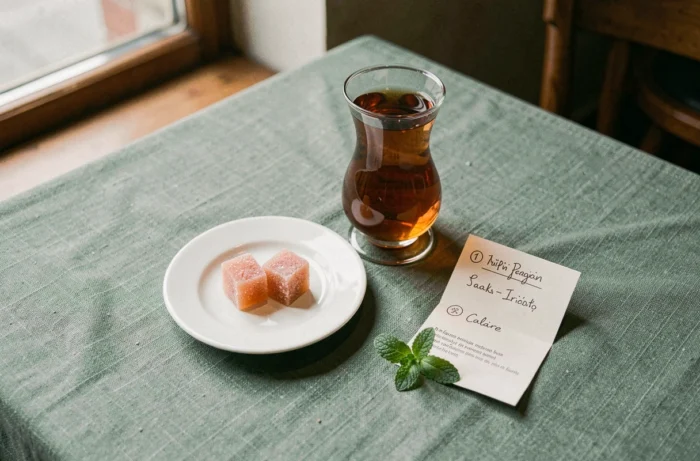
- Pair Turkish delight with a non-sweetened beverage (unsweetened Turkish coffee, green tea, herbal infusion) rather than with an already rich dessert. The taste pleasure remains intact without stacking sources of quick sugars.
- Making your own Turkish delights allows you to reduce the amount of sugar compared to industrial versions and choose fillings with a better nutritional profile (unsalted pistachios, fresh lemon zest).
- Fraction the portion: cut the Turkish delights into half-cubes before storing. The act of serving two small pieces instead of one large activates a more pronounced satiety signal.
Homemade Turkish delight, properly stored in an airtight box with cornstarch, lasts long enough to be enjoyed over several days without the pressure of quick consumption. It is precisely this time management that allows transforming a confectionery known for its calories into a measured pleasure without frustration.