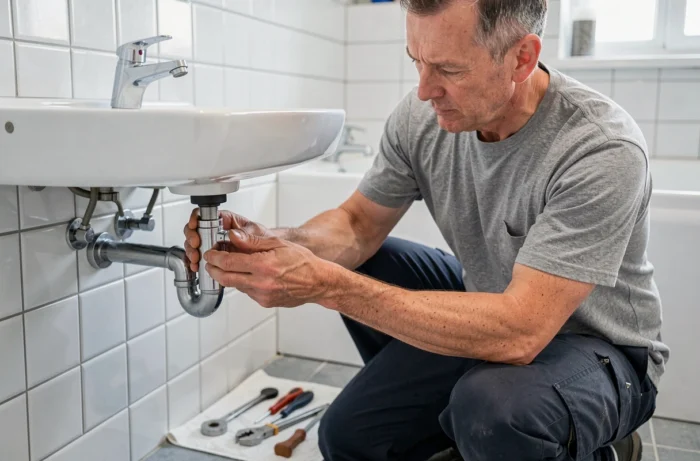
We are under the sink, wrench in hand, and the first question that comes to mind is not technical: do we turn left or right? The answer depends on the part you are looking at and the angle from which you observe it. This detail is enough to turn a ten-minute job into a hassle if you don’t establish the right reference points from the start. Faucet, siphon, drain: each element has its own disassembly peculiarities.
Direction of unscrewing: the basic rule and the perspective trap
The universal convention in screw fastening is simple: counterclockwise to loosen, clockwise to tighten. It is often summarized as “left to undo, right to tighten” when looking at the head of the screw or the nut facing you.
The problem arises as soon as you work under a sink. Viewed from below, the visual direction reverses. What seems to be “to the left” from underneath actually corresponds to a clockwise rotation on the nut. You end up tightening instead of loosening, with a real risk of breaking a seal or cracking a fragile basin.
To orient yourself, place the thumb of your right hand along the axis of the screw, finger pointing towards you: the other fingers curled indicate the tightening direction. If you want to know which way to unscrew a faucet, apply this trick by positioning yourself facing the connection nut of the hose, not from the back of the vanity.
Unscrewing a sink siphon without forcing
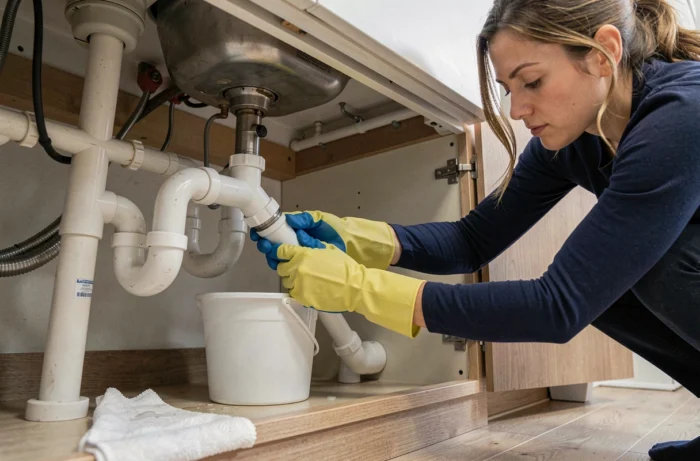
The siphon is the most accessible part under a sink, but it is also the one that accumulates the most deposits. Before touching anything, slide a bucket or basin underneath: the stagnant water in the trap will flow out as soon as the connection is broken.
Plastic PVC siphon
On a recent PVC model, the bottom (the rounded lower part) often unscrews by hand. Grasp the knurled ring and turn counterclockwise while looking at the siphon from below. If the ring resists, a pair of pliers with a cloth around the jaws prevents crushing the plastic.
Brass siphon or old siphon
On a metal siphon, seizing is common. A seized nut must be treated before forcing. Spray a penetrating oil, let it sit for several minutes, then resume with a wrench that provides a good grip. Increasing the effort without caution deforms the edges of the nut and makes disassembly even more difficult.
A point to check: some old siphons are glued and not screwed. If nothing moves despite the penetrating oil and the part seems fixed to the drain pipe, you are probably facing a glue. In this case, you need to cut the pipe and use a repair sleeve rather than persist.
Sink drain: secure the top before unscrewing the bottom
The drain connects the inside of the basin to the siphon. It consists of a visible part (the grille or flap) and a threaded body secured by a nut under the sink. The classic trap: you turn the lower nut and the entire drain pivots in its housing, never loosening.
Block the upper part with one hand or pliers while unscrewing the nut from below. On models with a pull rod, you can sometimes insert a flat screwdriver into the grille to hold it in place. On a click-clack drain, first unscrew the upper mushroom before tackling the securing nut.
- Remove the mushroom or grille visible in the basin, often by manually unscrewing counterclockwise
- Keep the drain body stationary from above with pliers or a screwdriver wedged in the notches
- Loosen the securing nut under the sink, always counterclockwise from below
- Check the condition of the seal between the drain and the basin before reassembling, as a crushed or hardened seal causes leaks
Faucet hoses: the trap of excessive tightening
The hoses that connect a faucet to the hot and cold water supplies end with a nut that has an integrated flat seal. The sealing relies on the compression of this seal, not on PTFE tape added to the threads. It is a common mistake to add it to this type of connection: the excess material prevents the flat seal from compressing properly.
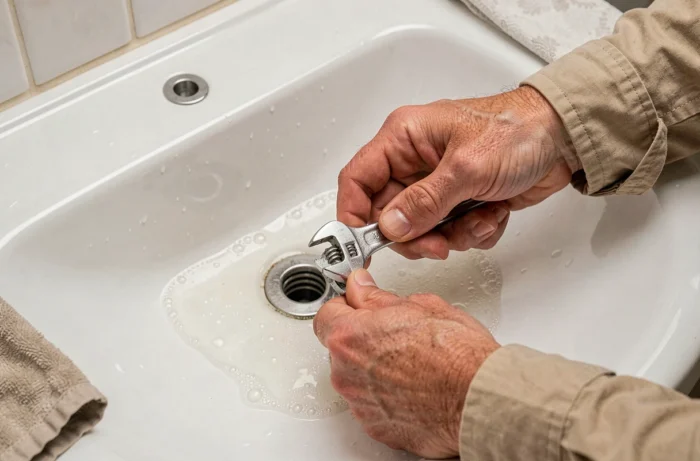
To unscrew a hose, hold the stopcock with a flat wrench and turn the hose nut counterclockwise with a second wrench. A manual tightening followed by a quarter turn with the wrench is sufficient for reassembly. Going beyond that crushes the seal and paradoxically causes a leak.
When the faucet itself needs to be removed
The faucet is secured under the sink by a threaded rod and a locking nut, sometimes accompanied by a clamping plate. You access this nut by sliding under the basin, often in an uncomfortable position. A basin wrench (or sink wrench) allows you to reach this nut without disassembling the entire cabinet.
The direction remains the same: counterclockwise to loosen. Feedback on this point varies by brand, but almost all faucets on the European market adhere to the standard convention. If the nut does not budge, check that it is not a clip system rather than a screw.
Materials to prepare before disassembling under a sink
- Adjustable pliers and a flat wrench suitable for the diameter of the nuts (often between 24 and 32 mm for common plumbing fittings)
- Bucket or basin to catch residual water from the siphon
- Pentrating oil spray for old metal fittings
- Thick cloth to protect chrome or plastic surfaces from the jaws of the pliers
- Household gloves, especially if chemicals have been recently poured into the sink
Shutting off the water supply before touching the faucet hoses seems obvious, but it is often forgotten when only working on the siphon or drain. Even for these parts, closing the stopcocks avoids an unpleasant surprise if someone turns on the faucet during the intervention.
The majority of these operations take only a few minutes once the correct rotation direction is identified. The reflex to maintain: always position yourself facing the nut you are turning, visually check the direction before applying pressure with the wrench, and never force without first eliminating any potential glue or seizing.